What the numbers mean
The UK's National Institute for Health and Care Excellence (NICE) classifies central adiposity, the fat you carry around your middle, by waist-to-height ratio:
| Ratio | VitalsCalc label | What it means |
|---|---|---|
| Under 0.40 | Below range | A very low ratio can go with being underweight. Talk to a doctor if you are concerned. |
| 0.40–0.49 | Healthy | Your waist is under half your height: no added risk from where you carry fat. |
| 0.50–0.59 | Increased risk | Fat around the middle raises the risk of heart disease and type 2 diabetes. |
| 0.60 and over | High risk | A high risk of heart disease and type 2 diabetes. Talk to a doctor about it. |
NICE uses the three bands from 0.40 up. VitalsCalc adds the "below range" flag under 0.40. The same bands apply to men and women and to all ethnicities, which makes the ratio simpler than waist size alone, where the cut-offs change with sex and background.
What should my waist be for my height?
Half your height. That is the whole rule. A few examples:
| Height | Keep your waist under |
|---|---|
| 5'0" (152 cm) | 30 in (76 cm) |
| 5'4" (163 cm) | 32 in (81.5 cm) |
| 5'7" (170 cm) | 33.5 in (85 cm) |
| 5'10" (178 cm) | 35 in (89 cm) |
| 6'1" (185 cm) | 36.5 in (92.5 cm) |
No tape measure? Cut a piece of string to your height, fold it in half and wrap it around your waist. If the ends meet, your ratio is under 0.5.
How to measure your waist
Where you put the tape changes the answer by an inch or more, so measure the same way every time. This is the method NICE gives:
- Find the bottom of your ribs and the top of your hip bones.
- Wrap the tape around your waist halfway between them. For most people that's just above the belly button.
- Keep the tape level and snug, not pulling in the skin.
- Breathe out normally, then read the tape. Don't suck in.
Then divide by your height in the same unit. Example: a 38-inch waist at 5'7" (67 inches) is 38 ÷ 67 = 0.57, in the increased-risk band.
Measure in the morning before eating, and compare readings a few weeks apart rather than day to day.
Why it often beats BMI
BMI uses only weight and height. It can't tell muscle from fat, or fat under the skin from fat packed around your organs. Fat around the middle is the kind most tied to type 2 diabetes, high blood pressure and heart disease, and your waist is the easiest place to see it.
A 2012 meta-analysis of studies with more than 300,000 adults found that waist-to-height ratio picked out people with these risk factors better than both BMI and waist circumference, in men and women.
That's why NICE now asks adults with a BMI under 35 to measure their ratio alongside BMI, not instead of it. Two people with the same BMI can have very different ratios. The one with the larger waist usually carries the higher risk.
Limits: when the ratio can mislead
- A BMI of 35 or more. NICE's bands are for people with a BMI under 35. Above that, NICE relies on BMI.
- Pregnancy. The bands don't apply.
- Children. NICE uses the same bands from age 5, but a child's ratio is best read with a doctor alongside their growth chart. VitalsCalc's bands are for adults.
- It's a screen, not a diagnosis. A ratio of 0.5 or more is a reason to check blood pressure, blood sugar and cholesterol, not proof of a problem.
For a fuller picture of how much of you is fat, see the body fat percentage guide.
Check your ratio in VitalsCalc
- Open VitalsCalc and tap Calculators → Waist-to-Height. Your height comes from your profile.
- Enter your waist. The screen reminds you where to measure.
- You see your ratio, its band, and the waist that keeps you under half your height, plus all four bands with yours highlighted.
- Your waist is saved to your profile, and the Body Fat calculator reuses it.
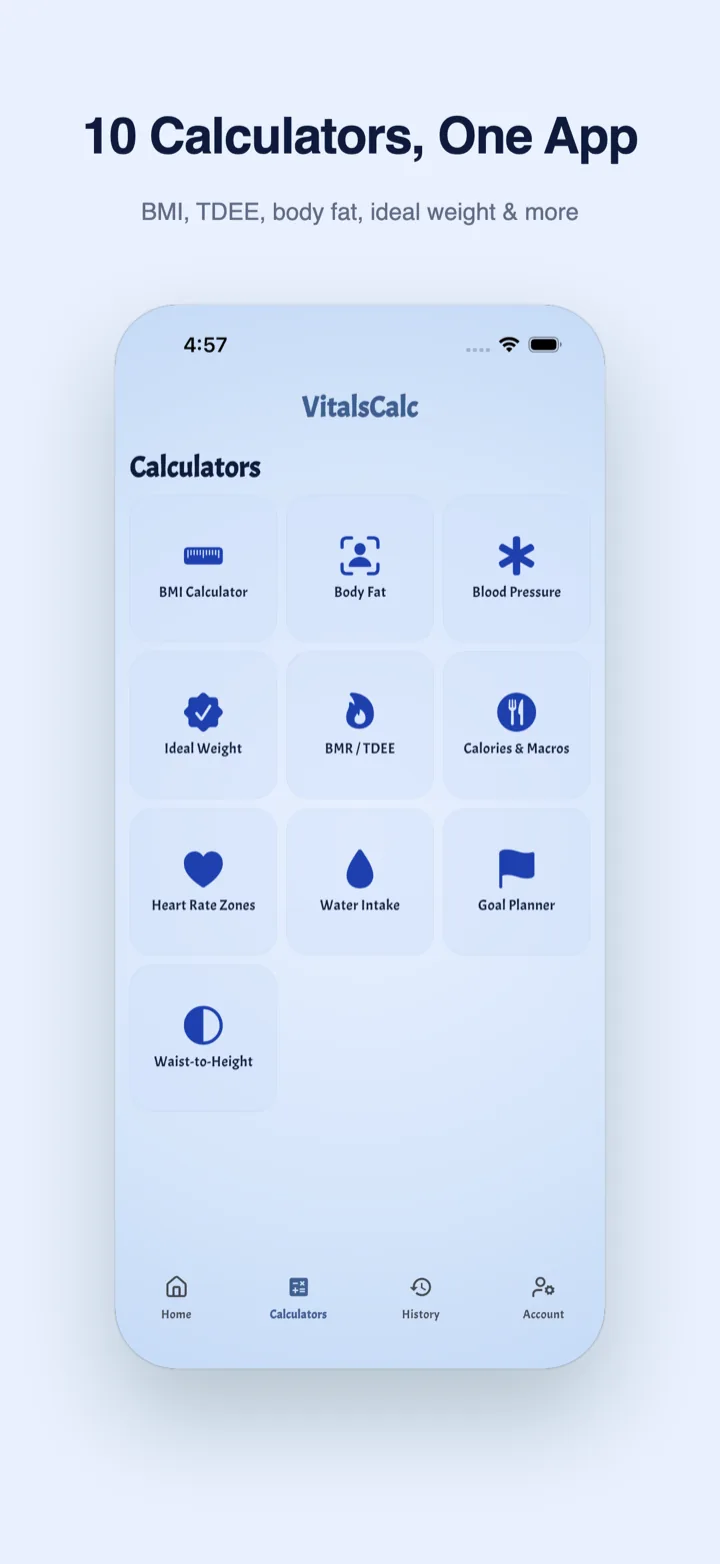
See every feature on the VitalsCalc health calculator app page. The calculators are free; Pro is a one-time unlock, with no subscription and no ads.
Waist-to-height questions, answered
Is the healthy waist-to-height ratio different for men and women?
No. NICE uses the same bands for both sexes and all ethnicities: 0.40–0.49 healthy, 0.50–0.59 increased risk, 0.60 or more high risk.
What should my waist be for my height?
Under half your height. At 5'7" (67 inches), that's under 33.5 inches. At 170 cm, under 85 cm.
Can I have a healthy BMI and a high waist-to-height ratio?
Yes. BMI can't see where fat sits. Someone with a normal BMI who carries fat around the middle can have a ratio of 0.5 or more, and the higher risk that goes with it.
Is waist-to-height ratio the same as waist-to-hip ratio?
No. Waist-to-hip ratio divides your waist by your hips and uses different cut-offs for men and women. Waist-to-height ratio divides by height, which doesn't change in adults, and uses one set of bands for everyone.
Does it work if I'm very muscular?
Better than BMI does. Muscle adds weight but not much waist, so a muscular person can have a high BMI and a healthy ratio. NICE says its bands can be used for adults with high muscle mass.
Sources
- National Institute for Health and Care Excellence. Overweight and obesity management (NG246): identifying and assessing overweight, obesity and central adiposity. 2025. The ratio bands, the "less than half your height" advice and the measuring method.
- Ashwell M, Gunn P, Gibson S. Waist-to-height ratio is a better screening tool than waist circumference and BMI for adult cardiometabolic risk factors: systematic review and meta-analysis. Obes Rev. 2012;13(3):275–286.
Get your numbers in VitalsCalc
Free to download on iPhone and Android.
VitalsCalc provides estimates for general informational and fitness purposes only and is not a substitute for professional medical advice, diagnosis, or treatment.