The quick estimate
Most goal weight calculators do one sum:
Weeks to goal = weight to lose ÷ weight lost per week
To get the weekly figure from a calorie deficit, they use the old rule of thumb that a pound of body weight holds about 3,500 calories (about 7,700 per kg). A 500-calorie daily deficit is 3,500 a week, so one pound a week.
| To lose | At 1 lb (0.45 kg) a week | At 2 lb (0.9 kg) a week |
|---|---|---|
| 10 lb (4.5 kg) | 10 weeks | 5 weeks |
| 20 lb (9 kg) | 20 weeks | 10 weeks |
| 30 lb (13.5 kg) | 30 weeks | 15 weeks |
| 50 lb (23 kg) | 50 weeks | 25 weeks |
Use this table as a first estimate, not a promise. It assumes a fixed deficit and a straight line. In real life the first week or two often run faster (that's water, below) and the later months run slower.
Why the 3,500-calorie rule runs fast
The 3,500-calorie figure dates back to a 1958 paper. It is a fair guide for the first few weeks. The problem is what happens next.
As you lose weight, you carry less tissue, so you burn less energy keeping it alive and moving it around. Eating less also lowers the energy you spend digesting food. So the deficit you started with shrinks on its own. If you eat 1,900 calories a day from start to finish, the deficit in month four is smaller than it was in week one, and so is the weekly loss. Weight curves toward a new, lower plateau instead of falling in a straight line.
Kevin Hall's team at the NIH built a model of this. Their 2011 analysis in The Lancet found that body weight responds slowly to a lasting change in intake, with a half time of about a year: it takes roughly a year to reach half of the total change that a new intake will eventually produce. It also found that people with more body fat lose more weight for the same cut in calories, but take longer to settle.
That's why a plan built on the straight line feels like it "stopped working" around month two or three. Nothing broke. The math was wrong from the start.
The first two weeks: mostly water
The opposite surprise comes first. Many people drop several pounds in the first week or two, far more than their deficit explains. Most of it is not fat:
- Glycogen and its water. Your body stores carbohydrate as glycogen, and each part of glycogen is held with three to four parts water. Eat less, and you use some of it up.
- Gut content. Less food going in means less food in your gut at any time.
Both come back when you return to maintenance calories. That's the "rebound" people see after a diet ends, and it's why the scale can jump a few pounds in the first days back to normal eating.
A useful rule of thumb from coaching: if you were holding steady before, expect about 2–4% of your starting weight to come off early from water, glycogen and gut content. If you were already dieting, that drop has already happened. It also means you should diet a little below your goal, so that you settle at the goal, not above it, once you eat normally again.
What pace is realistic?
The CDC notes that people who lose about 1 to 2 pounds a week are more likely to keep the weight off. For lifters and anyone who wants to keep muscle, a pace tied to body size works better: about 0.5–1% of body weight a week.
A percentage scales with you. 0.5% a week is 1 lb for a 200 lb person and 0.7 lb for a 140 lb person. And because it is a share of your current weight, it slows down a little as you get lighter, which is what really happens anyway.
What changes your timeline the most:
- How far you have to go. The last 10 lb take longer than the first 10 at the same intake.
- How big your deficit is. A bigger deficit is faster, but harder to keep, and it costs more muscle.
- Your body size and activity. A larger, more active body burns more, so the same intake makes a bigger deficit.
- How consistent you are. A deficit you keep five days a week and undo on the weekend is a much smaller deficit.
To find your own starting calories for a given pace, see how many calories you should eat. To pick a goal weight in the first place, see what's my ideal weight?
When a goal date is out of reach
Flip the question around: you have a date (a wedding, summer, the new year) and a goal weight. How much do you need to eat?
With a dynamic model, there is an honest answer, and sometimes it is "you can't, safely". If reaching the goal by that date would mean eating below your resting metabolic rate, the calories your body burns at complete rest, the goal is out of reach in that time. (If you plan to diet a little below your goal, as above, count that margin too.) A straight-line calculator will still hand you a date or a number. A good planner says no.
When that happens, you have three good options:
- Give it more weeks. Often a few extra weeks bring the needed intake back to something you can live with.
- Set a halfway goal. Reach it, hold it for a few weeks at maintenance, then go again.
- Move more. More activity raises what you burn, so the same goal needs a smaller cut in food.
Once you've started, judge progress by your weekly trend, not single weigh-ins. Daily weight swings by a pound or two with salt, carbs and sleep. A line through a week or more of weigh-ins tells you whether you're on pace.
Plan your goal date in VitalsCalc
VitalsCalc's Goal Planner is built on Chow and Hall's dynamic model of body weight, the line of research behind the NIH Body Weight Planner. It tracks fat, lean mass and glycogen day by day, so loss slows as your burn falls. It never asks you to eat below your resting metabolic rate.
- Open VitalsCalc and tap Calculators → Goal Planner. Your height, weight, sex, date of birth and activity come from your profile, and so does your body fat (or an estimate from your BMI if you haven't measured it). It plans for adults only.
- Enter a goal weight (or switch to a body fat goal) and set how many weeks you have, from 4 to 104.
- You get the daily calories that get you there and a chart of your projected weight. If no safe intake gets there in time, counting the margin in the next step, it says Not reachable by then instead of inventing a number.
- On a cut, the plan aims a little below your goal, so you settle at the goal once you eat at maintenance again. It also tells you how much of the early drop to expect as water. It reads that from your weigh-ins over the last two months; with too few, it assumes you've been holding steady and says so.
- Tap Use this plan. Its calories become your daily target, and a weekly check-in on Home compares your weigh-ins with the plan and suggests new calories if you're ahead or behind.
Already logging your weight? Weigh in regularly, and once the last four weeks show a clear trend toward your goal weight, the weight card on Home shows when you'll reach it at that pace, if it's within a year. That date runs your pace through the same model, so it doesn't assume a straight line. In the first two weeks of a diet, water makes the pace look faster than it is, so give it a few weeks before you trust the date.
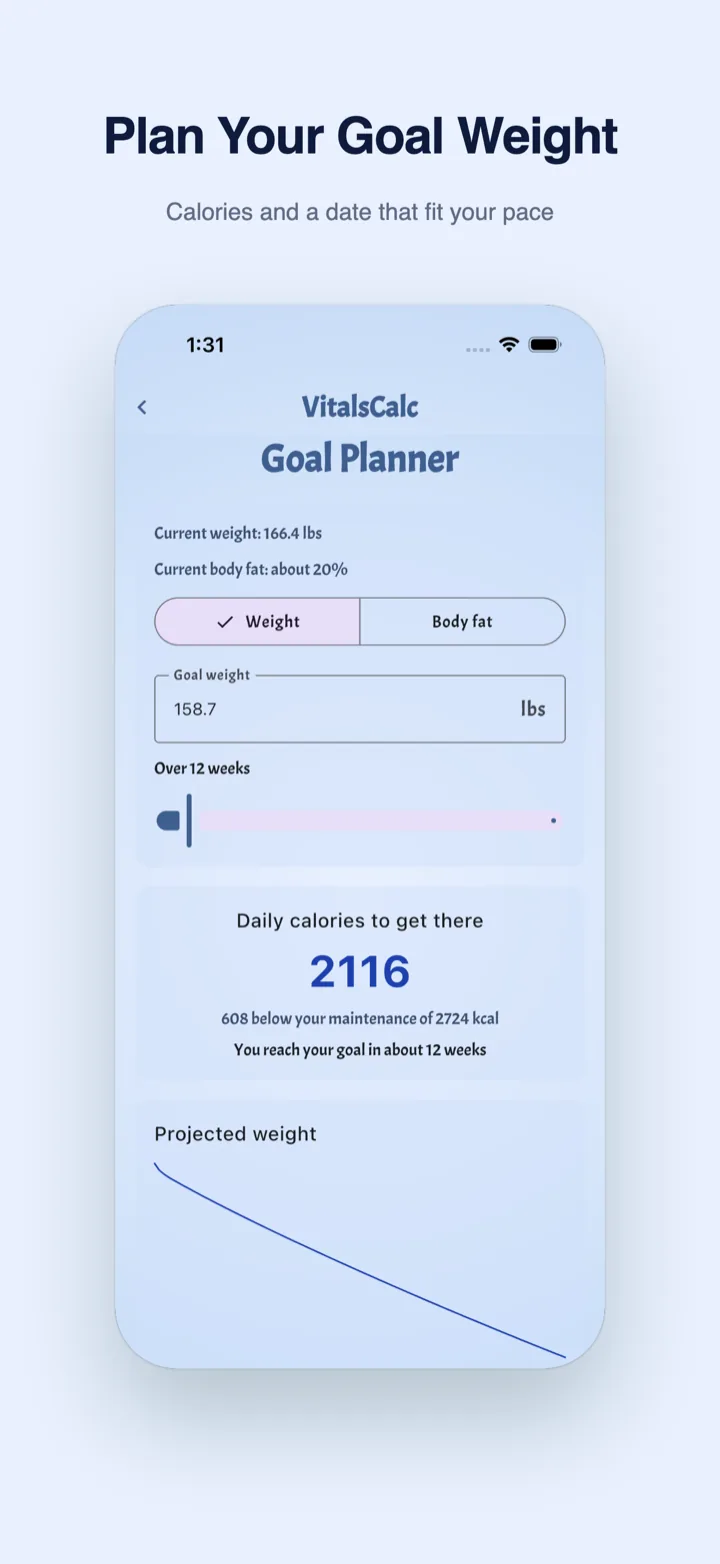
See every feature on the VitalsCalc health calculator app page. The Goal Planner is free; Pro is a one-time unlock, with no subscription and no ads.
Goal weight questions, answered
How long does it take to lose 20 pounds?
At a steady 1–2 lb a week, about 10–20 weeks. The later pounds come off more slowly than the first ones, so plan toward the longer end, especially if 20 lb is a large share of your body weight.
Why did I lose so much weight in the first week?
Most of it is water. Glycogen is stored with three to four parts water, and a smaller intake also means less food in your gut. Both drop in the first week or two. It's real weight on the scale, but not fat, and it comes back at maintenance calories.
Why has my weight loss slowed down?
A lighter body burns fewer calories, so the same intake becomes a smaller deficit. Progress flattens over time. That's normal, not a failure. To keep the same pace, lower intake again or move more.
Is the 3,500-calorie rule accurate?
For the first few weeks, roughly. Over months it overstates loss, because it assumes your energy burn stays fixed while you shrink. Dynamic models such as the one behind the NIH Body Weight Planner predict a slower, curving path.
What if my goal date isn't realistic?
Move the date, not the floor. If the goal would mean eating below your resting metabolic rate, give it more weeks or set a halfway goal. A goal that comes a few months later and sticks beats a crash diet you can't keep.
Sources
- Hall KD, Sacks G, Chandramohan D, Chow CC, et al. Quantification of the effect of energy imbalance on bodyweight. Lancet. 2011;378(9793):826–837. Weight responds to a change in intake with a half time of about a year.
- Chow CC, Hall KD. The dynamics of human body weight change. PLoS Comput Biol. 2008;4(3):e1000045. The model the VitalsCalc Goal Planner implements.
- National Institute of Diabetes and Digestive and Kidney Diseases. Body Weight Planner. Based on Hall et al. (2011).
- Wishnofsky M. Caloric equivalents of gained or lost weight. Am J Clin Nutr. 1958;6(5):542–546. The 3,500 calories per pound rule.
- Kreitzman SN, Coxon AY, Szaz KF. Glycogen storage: illusions of easy weight loss, excessive weight regain, and distortions in estimates of body composition. Am J Clin Nutr. 1992;56(1 Suppl):292S–293S.
- Centers for Disease Control and Prevention. Steps for Losing Weight.
- Helms ER, Aragon AA, Fitschen PJ. Evidence-based recommendations for natural bodybuilding contest preparation: nutrition and supplementation. J Int Soc Sports Nutr. 2014;11:20. The 0.5–1% a week rate of loss.
Get your numbers in VitalsCalc
Free to download on iPhone and Android.
VitalsCalc provides estimates for general informational and fitness purposes only and is not a substitute for professional medical advice, diagnosis, or treatment.