The four hand portions
| Hand portion | Food group | About | Examples |
|---|---|---|---|
| Palm (thickness and width of your palm) | Protein | 20–30 g protein | Chicken, fish, lean meat, eggs, tofu, Greek yogurt |
| Cupped hand | Carbohydrate | 20–30 g carbs | Rice, oats, pasta, potatoes, beans, fruit |
| Thumb (the whole thumb) | Fat | 7–12 g fat | Oils, butter, nut butter, nuts, cheese |
| Fist | Vegetables | About 1 cup | Leafy greens, broccoli, peppers, carrots |
Using hands to estimate portions has been part of nutrition education for decades, taught by the USDA and the Academy of Nutrition and Dietetics. It works because hand size scales roughly with body size: a bigger person has bigger hands and naturally serves bigger portions.
The hand-portion method was popularized by Precision Nutrition.
Coaches and trainers: a one-page hand portion client handout (the four portions, with a space for the client's daily and per-meal numbers) is free to print or download as a PDF.
How the calculator works
- Resting burn (BMR) from the Schofield (1985) equations, which use your sex, age and weight. They're the basis of the BMR equations in the FAO/WHO/UNU energy report, and they don't need your height.
- Daily burn (TDEE): your BMR times an activity level set by your day and your exercise. Separating the two avoids the usual muddle where a desk worker who trains daily and a builder who never trains get the same answer.
- Goal calories: a rate of weight change scaled to your weight, using 7,700 calories per kg (3,500 per lb). Your target never drops below your BMR.
- Macros: protein at 0.8 g per pound of body weight (1.0 g per pound while losing), fat at 25% of calories but never under 0.35 g per pound, and carbs fill the rest. More on the logic in the calories and macros guide.
- Hands: grams divided by 25 (protein), 25 (carbs) and 9.5 (fat), rounded to whole portions. Vegetables are one fist per meal rather than a computed number, since they barely move a macro split.
These are the same formulas, in the same order, as the default settings in the VitalsCalc app, so the web calculator and the app agree.
How many palms of protein per meal?
Take your daily palms and divide by the meals you eat. For a 40-year-old, 180 lb man with a desk job who exercises a few hours a week, maintenance comes out at about 2,700 calories, 147 g protein, 75 g fat and 362 g carbs: 6 palms, 14 cupped hands and 8 thumbs a day. Over four meals that's about 1½ palms, 3½ cupped hands and 2 thumbs each, plus a fist of vegetables.
A 35-year-old, 140 lb woman with the same routine who wants to lose 0.5% a week lands at about 1,700 calories: 6 palms, 7 cupped hands and 5 thumbs a day. Protein holds steady while calories come down, which is what protects muscle on a diet.
Adjusting your portions
The numbers are a starting point. Follow them consistently for two weeks and weigh yourself several times a week. If the trend doesn't match your goal, change the portions a little at a time, usually one cupped hand of carbs or one thumb of fat a day, then give it another two weeks. Keep protein where it is unless your weight changes a lot.
When hand portions aren't enough
Hands are estimates. Real foods mix nutrients (cheese is protein and fat, beans are carbs and protein), portions drift, and a sauce or cooking oil can add several thumbs of fat without anyone noticing. If you're preparing for a competition, managing a medical condition, or not seeing the change you expect after a few weeks, weigh your food for a while to calibrate your eye.
Get your hand portions in VitalsCalc
- Open VitalsCalc and tap Calculators → Calories & Macros. Your age, sex and weight come from your profile.
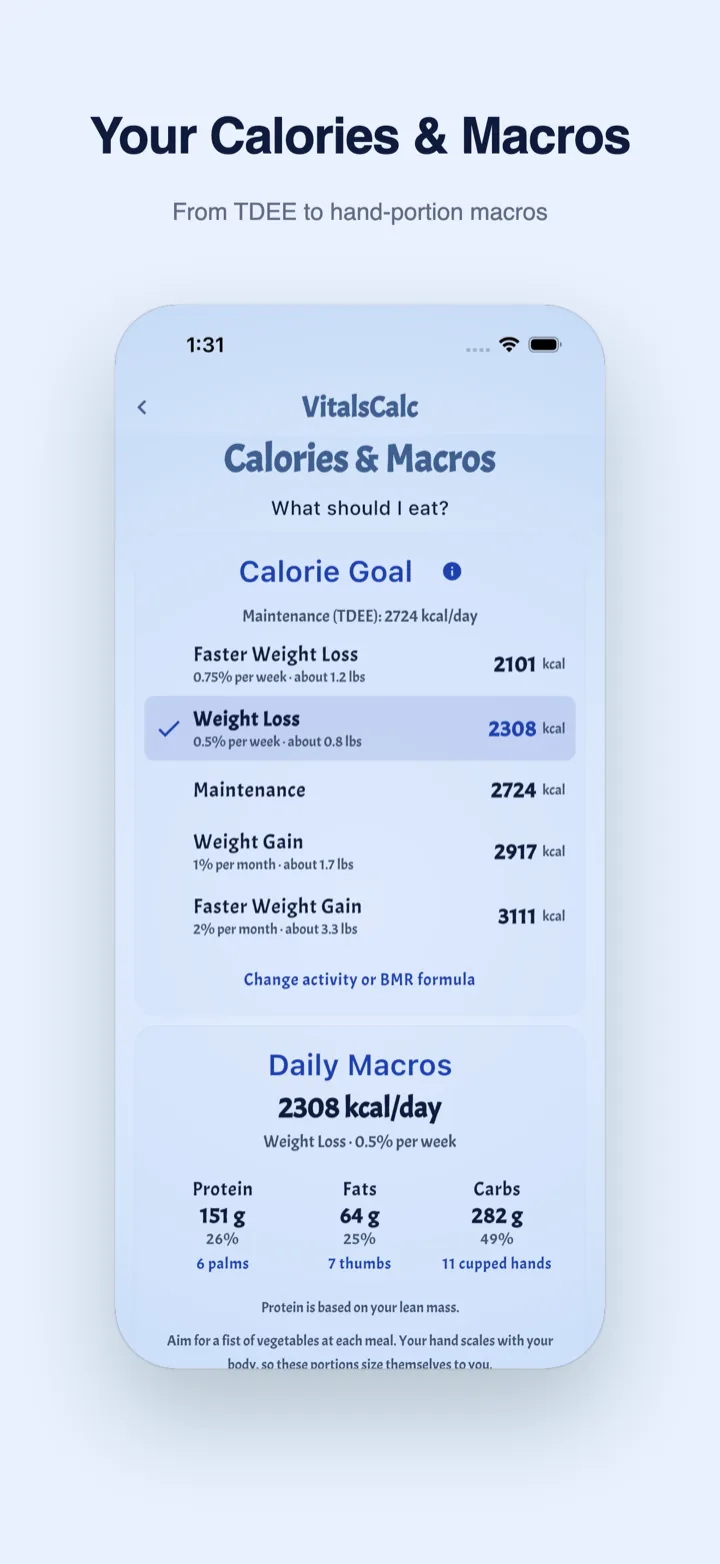
- Pick a goal. Daily Macros shows your calorie target and your protein, fat and carb grams, each with its hand-portion equivalent underneath.
- Add a body fat reading or a goal weight to your profile, and protein follows your lean mass or goal weight instead of your current weight, which is closer for people carrying more body fat.
- Log your weight as you go. The trend tells you whether the portions are working.
See every feature on the VitalsCalc health calculator app page.
Hand portion questions, answered
How many grams of protein is a palm?
About 20–30 g for a palm-sized portion of meat, fish, eggs, tofu or Greek yogurt. The calculator uses 25 g.
Do bigger hands mean bigger portions?
Yes, and that's the point. Hand size tracks body size well enough that a larger person's palm is a larger serving, which roughly matches their larger needs.
Are hand portions accurate?
They're estimates, not measurements. They're close enough for most people to follow a plan without a scale, and you correct the remaining error by watching your weight trend and adjusting.
Sources
- Precision Nutrition. Forget calorie counting: Try this calorie control guide for men and women. The palm, fist, cupped-hand and thumb system.
- Schofield WN. Predicting basal metabolic rate, new standards and review of previous work. Hum Nutr Clin Nutr. 1985;39 Suppl 1:5–41. The BMR equations the calculator uses.
- Food and Agriculture Organization, World Health Organization, United Nations University. Energy and protein requirements. Report of a Joint FAO/WHO/UNU Expert Consultation. WHO Technical Report Series 724. Geneva: WHO; 1985. Its BMR equations were based on Schofield's analysis.
- Wishnofsky M. Caloric equivalents of gained or lost weight. Am J Clin Nutr. 1958;6(5):542–546. The 7,700 calories per kg (3,500 per lb) rule.
- The calories guide's sources cover the other BMR formulas and the rates of weight change.
Get your numbers in VitalsCalc
Free to download on iPhone and Android.
VitalsCalc provides estimates for general informational and fitness purposes only and is not a substitute for professional medical advice, diagnosis, or treatment. Talk to a doctor or registered dietitian before changing your diet if you are pregnant, have diabetes, kidney disease or another medical condition, or have a history of disordered eating.